




Conservation officer
Local planning authorities generally employ, or retain the services of, a conservation officer. Sometimes this role may be combined with that of archaeological officer, although they are very different, albeit related, functions. The role can also be referred to as Historic buildings inspector.
The conservation officer’s role is to ensure the heritage assets of the local authority are preserved, managed, enhanced and promoted.
The involvement of local authority conservation officers in development proposals might include:
- Offering pre-application advice on the location, form and character of developments that may affect listed buildings, conservation areas, scheduled monuments or other heritage assets.
- Assessing planning applications for new developments that may affect heritage assets and proposing planning conditions that might be imposed on permissions.
- Agreeing inspection cycles.
- Visiting sites and carrying out inspections and surveys.
- Assisting enforcement action.
Managed intelligently the conservation of heritage assets need not disrupt developments. However, this often requires engagement with the local planning authority’s conservation officer as soon as possible if it is suspected that proposals may affect heritage assets. This will help identify the procedures that must be followed and avoid abortive work.
Other activities undertaken by a local authority conservation officer might include:
- Maintaining information about heritage assets.
- Surveying assets that are at risk.
- Estimating restoration and conservation costs.
- Advising owners of buildings at risk or redundant buildings.
- Advising on policy measures and controls both locally and nationally.
- Advising on regeneration projects affecting heritage assets.
- Sourcing grants and other funding for conservation work.
- Championing heritage issues in the local authority and the wider community.
- Liaison with Historic England.
- Implementing schemes to conserve heritage assets.
- Advising on the designation of heritage assets.
- Canvassing public opinion and dealing with public enquiries.
- Planning and supervising long-term environmental projects.
- Assisting with enforcement action to protect threatened buildings or conservation areas.
The activities of conservation officers are most effective when they are embedded in the local planning authority, rather than being seen as an add-on.
NB. Conservation officers may also be employed by non-departmental public bodies or charitable trusts such as English Nature, the Countryside Agency, English Heritage, Historic England, the National Trust and so on, as well as by central government and by private consultancies.
[edit] Related articles on Designing Buildings Wiki
- Archaeological officer.
- Are works to listed buildings demolition or alteration?
- Archaeology and construction.
- Building preservation notice.
- Cautions or formal warnings in relation to potential listed building offences in England and Wales.
- Certificate of immunity.
- Charging for Listed Building Consent pre-application advice.
- CIAT shares IHBC research into LA conservation service capacity.
- Conservation.
- Conservation areas.
- Conservation officers in historic towns.
- Conservation practice survey 2016.
- English Heritage.
- Forced entry to listed buildings.
- Historic England.
- Historic Environment Service Provider Recognition.
- How to make conservation areas work.
- Is conservation area policy fit for purpose 50 years on.
- Listed buildings.
- Local authority conservation specialists jobs market 2014.
- Loss of senior conservation staff and posts in England March 2010 to April 2011.
- National Planning Policy Framework.
- Negotiating listed building consent.
- Negotiating skills for conservation professionals.
- Planning authority duty to provide specialist conservation advice.
- Scheduled monuments.
- Sharing local authority conservation services.
- Society for the Protection of Ancient Buildings.
- The history of conservation areas.
- Tree preservation order.
- Use of direct action in heritage enforcement cases in England.
- What makes a heritage-at-risk officer.
[edit] External references.
IHBC NewsBlog
IHBC sponsors Gardens Trust event 23-4 Sept 2026
.jpeg)
'Learning from the Past, Shaping the Future’ takes place in Milton Keynes
Renovations to Frank Lloyd Wright's Fallingwater complete
.jpg)
World Heritage Preserved project opens house for tours again
Shakespeare Birthplace Trust places Hall's Croft on HAR Register
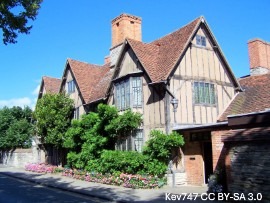
Stratford-upon-Avon home of Shakespeare's daughter is 'At Risk'
Lady Grange’s House repaired on St Kilda
.jpg)
National Trust for Scotland repairs stone cleit with link to famous island resident
Griff Rhys Jones on BBC Radio 4 Today programme
,_Green_Lane,_Derby.jpg)
The Victorian Society’s President unveiled its latest Top Ten Endangered Buildings 2026.
Need a MATE? Book your place now.

IHBC offers free webinars on applying for IHBC accreditation (Full & Associate).
UK Stained Glass Repository finds windows new homes
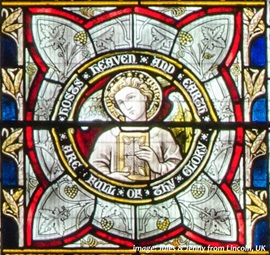
How are stained glass windows are rescued, stored and repurposed?
APPGEBE report sets high aims for quality
'Government must not sacrifice quality in drive to build 1.5m homes'
New measures protect Historic Shipwrecks from heritage crime

Underwater cultural heritage benefits from new HE guidance
How could the City of London skyline look in 6 years' time?

Visualisation shows approved planning applications as completed buildings
National Trust for Scotland calls for VAT cuts

Heritage neglect is encouraged by current policies
IHBC's 'Context' Issue 186 features Industrial Heritage
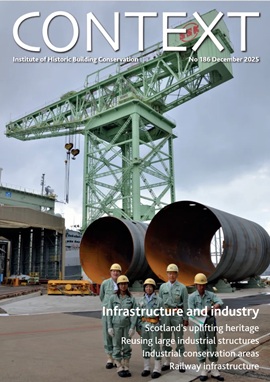
IHBC's members' journal reports on the challenges of conserving infrastructure
Book now for IHBC Annual School 2026
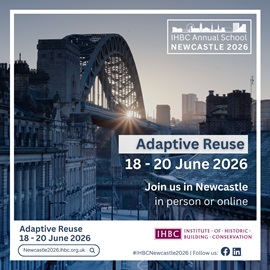
IHBC Annual School is taking place 18-20 June 2026 in Newcastle
RICHeS Research Infrastructure offers ‘Full Access Fund Call’
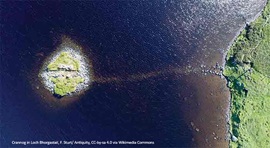
RICHeS offers a ‘Help’ webinar on 11 March
Latest IHBC Issue of Context features Roofing
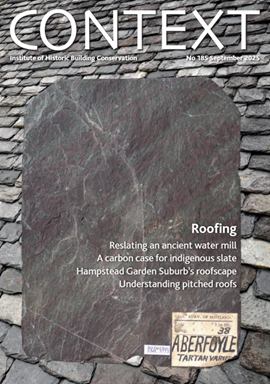
Articles range from slate to pitched roofs, and carbon impact to solar generation to roofscapes
Three reasons not to demolish Edinburgh’s Argyle House

Should 'Edinburgh's ugliest building' be saved?
IHBC’s 2025 Parliamentary Briefing...from Crafts in Crisis to Rubbish Retrofit
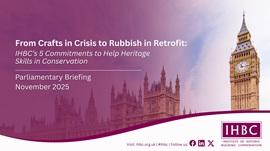
IHBC launches research-led ‘5 Commitments to Help Heritage Skills in Conservation’
How RDSAP 10.2 impacts EPC assessments in traditional buildings

Energy performance certificates (EPCs) tell us how energy efficient our buildings are, but the way these certificates are generated has changed.